



Consider the following, something Jason Fried wrote about marketing. Set aside the focus on marketing and, instead, understand what he wrote as being about communication:
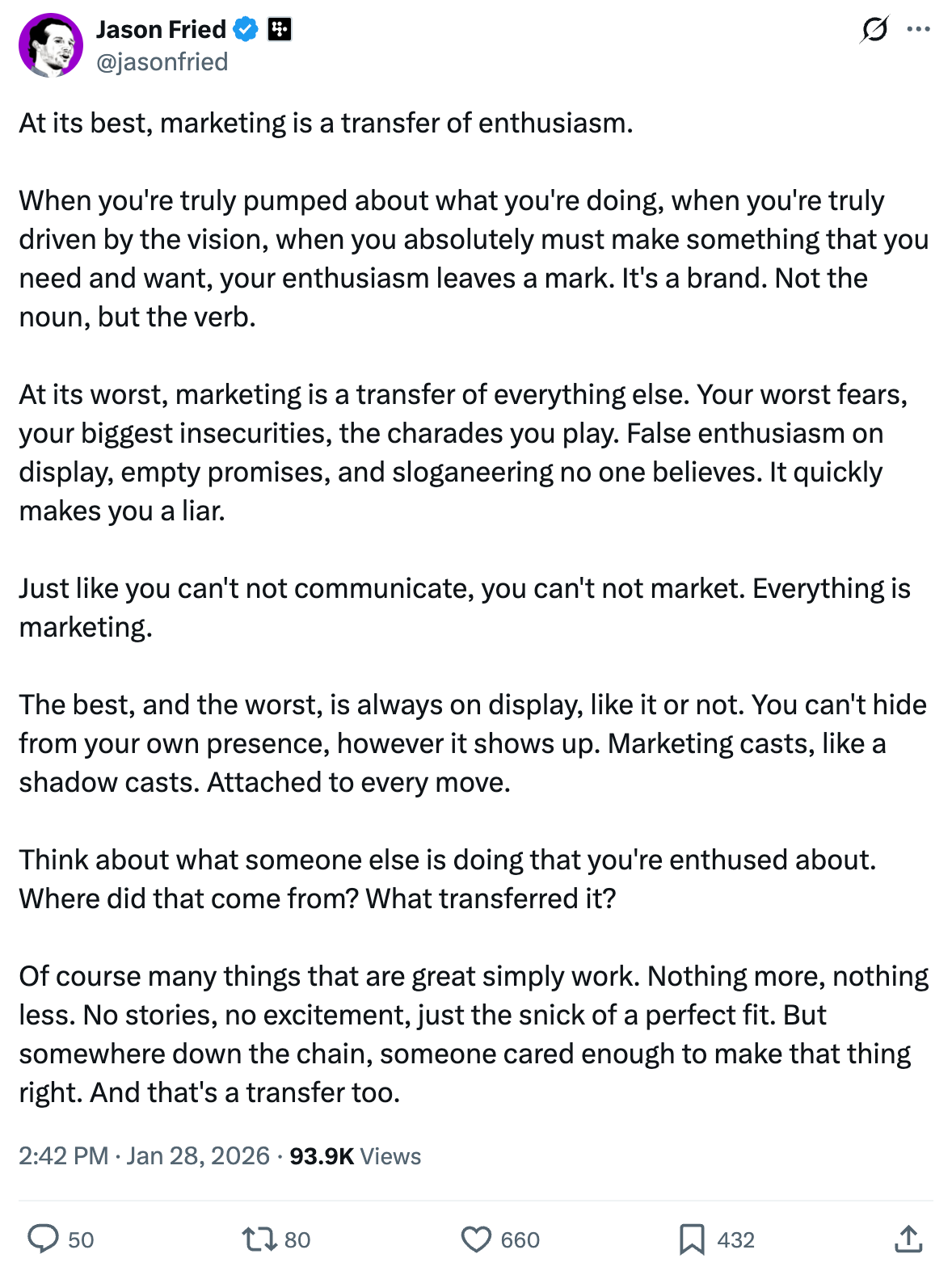
“Just like you can’t not communicate, you can’t not market … the best, and worst, is always on display, like it or not.”
People are always communicating, and what’s communication is always much more than what’s written or said.
What the showing tells
Early in life the child is told, “Actions speak louder than words.” This simple lesson, as understood to mean what you do matters more than what you say, somehow escapes application to communication itself.
Does the child ever learn what the act of speaking says?
The insight is that communication is a kind of “revealed preference,” a showing by telling. Applied, if you want to know what a person believes, forget what they say, and watch what they do. Their behavior reveals the truth.
Communication is, superficially, what’s said, written, expressed concretely. Viewed through revealed preference theory, the truth of communication is first revealed by the act of communication, regardless of what or how the communication takes place. The communicator reveals they feel something must be communicated. The audience should ask, “Why do they feel that way? What does that say about the communication?”
Second, and what’s in focus going forward, is how the communicator expresses their ideas also reveals what they, in fact, believe.
Actions speak louder than their words.
By understanding the “how” of communication, you begin to understand why AI writing so often falls short of being convincing. You’ll be closer to understanding why your intuition is telling you what you’re hearing, reading, seeing is true or false.
To detect the truth requires a mad method
The Un•AI•ify app was designed around understanding how communication supports, or betrays, the communicator. The hypothesis put forth by Un•AI•ify’s operation is that AI-generated writing over-relies on rhetoric, a byproduct of what it learned from people.
Un•AI•ify, as of this writing, anchors on highlighting a handful of writing patterns, “clues” of AI writing: “It’s not X. It’s Y,” “Lady doth protest,” “But reverse!,” “Clichés,” “Buzzwords,” and even the beloved (now maligned) em dash.
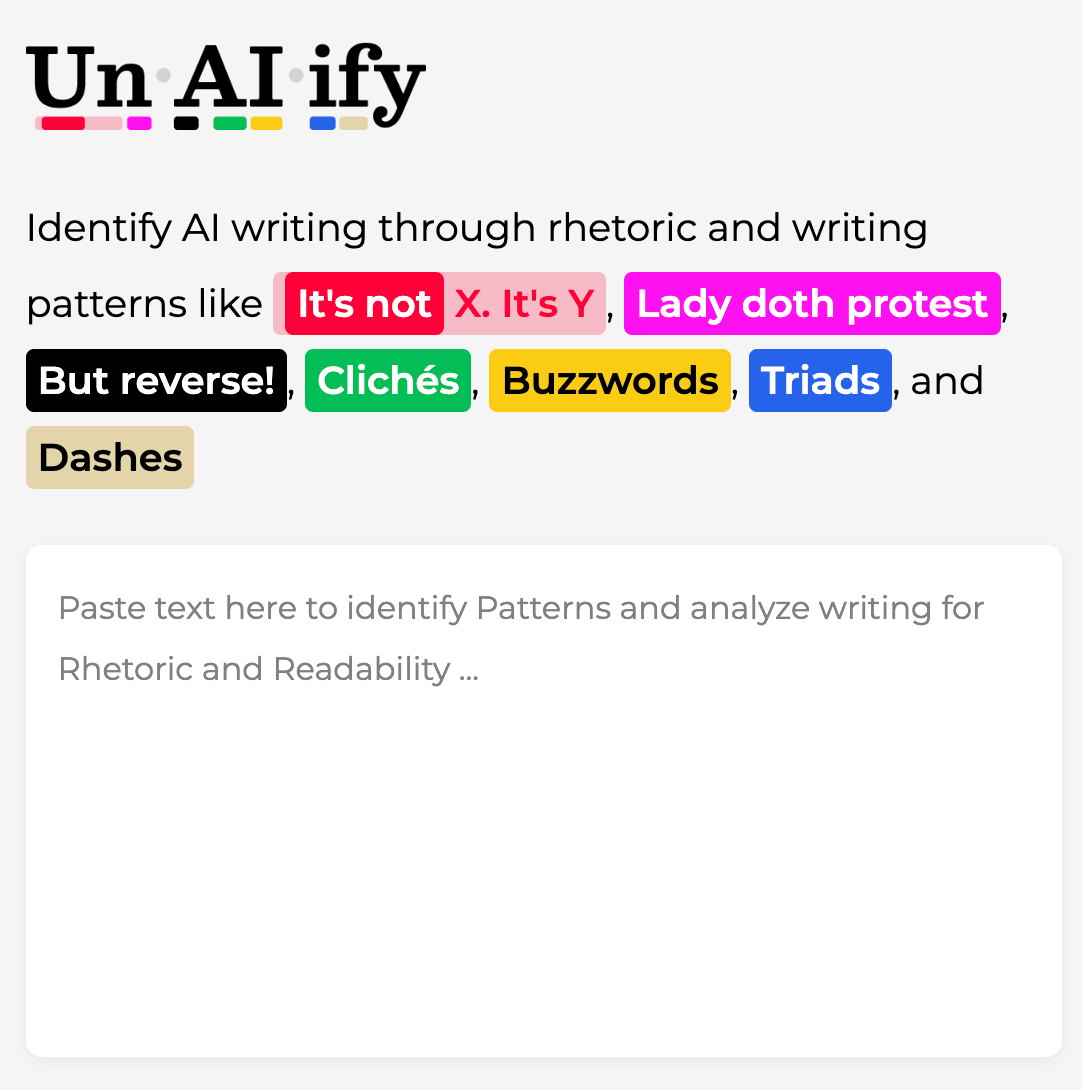
These overly used writing patterns help reveal clues that point to the truth behind whatever’s communicated. Just like us, AI can’t help itself but communicate. And just like us because it learned how to communicate from us, AI tells on itself too.
AI goes overboard with the use of specific writing patterns, including certain words that go hand-in-hand with those writing patterns. To put it as simply as possible:
AI tries too hard. The AI doth protest too much.
Learn these patterns (and more importantly the concepts behind them) to develop the best AI detection app: Your judgment. You can also learn to spot rhetoric (and bull), a skill becoming more important as the hyperinflation of content continues.
It’s not X. It’s Y
“It’s not X. It’s Y” phrases use denial, refutation, negation, and downplaying of one idea in order to promote another. The pattern is an alley-oop, offering the reader a head-nodding “not” statement (something they’re likely to readily accept) only to dunk on the reader with a statement of affirmation, “It’s Y,” which is the idea they want to push.
What keeps the affirmation, “It’s Y!” from standing on its own two feet? Why must one idea be refuted first in order for another to be promoted? “It’s not X. It’s Y” tells on itself.
Lady doth protest
Or take “Lady doth protest.” The “lady doth protest too much, methinks” is a quote from Queen Gertrude in Shakespeare’s Hamlet. Queen Gertrude’s comment came while watching Hamlet’s play within the play. Gertrude observed a woman insisting that, were her husband to die, she would never remarry. The queen felt this woman was trying too hard in the telling, she “doth protest too much,” and in doing so, revealed she didn’t feel as strongly about her convictions as she was stating. By comparison, confidence is plainspoken. Succinct.
To believe, to have the courage of our convictions, demands we state them plainly. Similarly, Twain’s “When you catch an adjective, kill it,” suggests simplifying language to make it stronger. Flowery language can undermine communication.
Buzzwords
Buzzwords are most popular in business contexts, contexts in which professionals (historically) donned ties and now swoon over titles. Buzzwords tantalize the communicator with the prospect that, having adopted the language of the priestly class, what’s said is closer to God.
Words like “leverage,” “optimize,” “efficiency,” “innovation,” and too many others to mention play dress up games with language. Used to excess, buzzwords cloy the audience and betray the communicator.
Do not be fooled.
Clichés
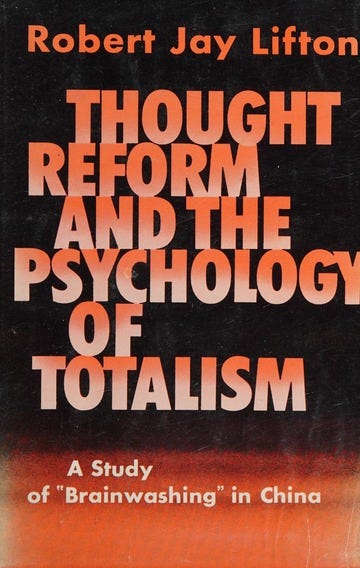
Clichés first offer an easy way to sum up an idea. The cliché first hypnotizes the communicator before lulling the audience into a slumber of predictability. Clichés risk terminating thought for both groups, something noticed and illuminated by Robert Lifton, who coined the expression “thought-terminating cliché” in his 1961 book titled “Thought Reform and the Psychology of Totalism.” Lifton wrote:
The language of the totalist environment is characterized by the thought-terminating cliché. The most far-reaching and complex of human problems are compressed into brief, highly reductive, definitive-sounding phrases, easily memorized and easily expressed. These become the start and finish of any ideological analysis.
... Totalist language then, is repetitiously centered on all-encompassing jargon, prematurely abstract, highly categorical, relentlessly judging, and to anyone but its most devoted advocate, deadly dull: in Lionel Trilling's phrase, "the language of nonthought."
Lifton’s book has been called the “bible on brainwashing.” Time to wake up.
But reverse!
Then there’s “but,” as with Un•AI•ify’s “But reverse!” Communicators inject “but” to reverse sentiment, to offset conviction, and (most importantly) to get their audience to lean in. “‘But’ means something is different. Pay more attention!” Commit to memory Nassim Nicholas Taleb’s observation: “Everything before the ‘but’ is meant to be ignored by the speaker; and everything after the ‘but’ should be ignored by the listener.”
— (em dashes)
Last of note are the em dashes, so loved by writers “in the know” while being something like the grammatical equivalent of deus ex machina for everyone else. The “—” is less a tell than the rest, but a tell in its own right even for writing from people. This goes back to the hypothesis that when a communicator must dress up their ideas to make them seem valuable, they risk diminishing the merits of the ideas themselves.
Communication revelation
The Un•AI•ify app is simple in how it is built to look for the above patterns as a means to reveal clues about writing being of AI provenance. While LLMs aren’t aware of any of this (unless you believe AI is conscious), AI generation is probabilistic: it predicts what should come next based on their training.
AI learned well from us all, and we love to dress up communication.
Blaise Pascal wrote, “Je n’ai fait celle-ci plus longue que parce que je n’ai pas eu le loisir de la faire plus courte,” which I’m told could be translated into: “I have made this longer than usual because I have not had time to make it shorter.”
Consider the revealed preferences of communication. Use the Un•AI•ify app on your own writing to reveal how, like in Hamlet, you protest too much. Ask what you really believe. If you’re using AI, use the app to highlight the sophistry at work. Ask questions and edit down to what you believe is true.
We tell on ourselves with communication, leaving clues for others and ourselves as to what we really believe. Play the detective and interrogate the communications around you. Learn how to listen to your intuition.
Taleb also said that, “What can be phrased and expressed in a clear narrative that convinces suckers will be a sucker trap.” AI expresses everything in a clear narrative, and no one wants to be a sucker.
The floodwaters of “fiat content” are rising. Swim on the surface if you can. The choice is yours.
The hyperinflation of content

A recent poll of 4,484 people found that 57% stop reading once they know the content was written by AI. The results: